
Release of hand-reared flying-foxes
Flying-foxes rescued from mothers electrocuted on powerlines, or entangled in fruit-tree netting, were being reared by volunteers. To release them into the wild, a cage was purpose-built in Ku-ring-gai Flying-fox Reserve.
To find out the best time to release the juveniles, a research project was undertaken in association with the University of New South Wales.
- Radio-tracking of hand-reared flying-foxes at Gordon — summary (PDF)
- Radio-tracking study, Augee & Ford — full report (PDF)
Flyout counts
To estimate the number of flying-foxes in the camp, volunteers began "counting" how many flew out of the valley at dusk. Counters stood at various locations around the reserve where they had a view across the direction of flight. This began in 1995, in association with the research on releasing rescued, hand-reared pups.
The counts are conducted by volunteers and, in recent years, by Council officers, who report them to the Australian Flying-fox Monitor.
See the flyout count record for the reserve →
Australian Flying-fox Monitor
In 2026 the Australian Flying-fox Monitor was able to save data from counts of camps across New South Wales in real time. Local government officers upload the counts for their area each month.
Camp extents
The grey-headed flying-foxes have occupied different parts of the reserve over time. Records were collected from Puddicombe and Buchanan, and by KBCS volunteers and Council staff. Sudden changes in the area occupied have occurred when there has been an influx of flying-foxes in response to intense flowering of eucalypts in surrounding national parks. As many leave for other camps, the remainder concentrate in a new part of the reserve.
Council officers now map the extent of the camp each month and estimate the number of flying-foxes present on the same day.
Drones with thermal imaging are now being used to estimate the numbers in camps, but have not yet been employed here. Surprisingly, the flying-foxes are not disturbed by the drone, provided it remains at an optimum distance from them.
See how the camp has moved within the reserve →
Temperature and humidity monitoring
A weather station was installed in the reserve by KBCS in 2018 to monitor temperature and humidity. The data showed that on hot days the flying-foxes move to cooler, more humid parts of the valley rather than simply enduring the heat where they are.
Read about the response to heat stress →
Measuring sound and noise impacts on neighbours
In 2013 and 2014, new residents moving into houses near the flying-fox camp complained to Ku-ring-gai Council about the noise of the flying-foxes, especially at night. They first asked for the removal of all the trees, then, after negotiations, for a 10-metre buffer.
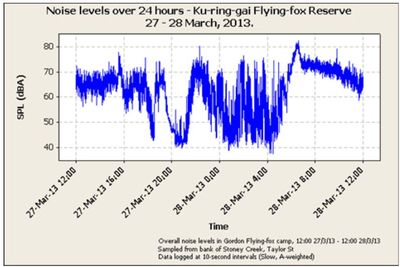
KBCS member Tim Pearson measured the sound and provided the data to Council. Tree removal on the very steep slopes was not supported, because it would destabilise the slopes near the houses. Ultimately, some trees were removed adjacent to houses.
The impact of flying-fox noise on people near other camps was well known to the NSW Government, which responded with a program of financial assistance to residences, through local councils, to provide double glazing, insulation and air conditioning.
Why the noise starts again late in the evening
After flyout at around 7:30pm it is quiet for a while — until the bats return, starting at about 9:30pm.
What is happening is that the adult males have set up territories and are defending them so they are not usurped. They fly out as normal, grab a quick feed, then fly back to the camp to make sure no-one else takes their piece of branch. They give a high-pitched short shriek any time anyone goes near it — and with other males flying back in and neighbours moving around, that is more or less constantly.
The difficulty from a human perspective is the pitch. It does not measure much louder than other noise, but it is perceived as far louder, and it starts earlier in the evening and goes on for much longer.
What difference would a 10-metre buffer make?
Predicting sound levels is an inexact science, but some general predictions can be made from physics and from measurements taken in the actual environment.
- A 10-metre cleared buffer between properties and the camp can realistically be expected to make a difference of about 2–4 dBA to the sound levels residents experience.
- The reduction depends on multiple factors, including how far back the residence already sits from the camp, and the shape and elevation of the surrounding land.
- That difference is certainly noticeable, but it is not enough to bring noise levels below the threshold of awareness.
- How annoying a noise is depends not only on volume, tone and frequency, but on the listener's opinion of the source.
- As with road, rail and aircraft noise, the simplest solution is often to adjust the human environment rather than the natural one — sound walls at community scale, or double glazing and insulation at individual scale.
Measurements at 10 metres and 20 metres from the edge of the camp showed roughly a 2–3 dB reduction as the distance doubled. Sound insulation only works if it is done thoroughly: double glazing achieves little if the roof is uninsulated or there are gaps elsewhere, because sound will find any path it can. Measurements inside a properly insulated, double-glazed house showed a remarkable reduction.
References
- Everest, F.A., & Pohlmann, K.C. 2009. Master Handbook of Acoustics (5th ed.). McGraw Hill.
- Office of Environment and Heritage, NSW. 2011. NSW Road Noise Policy.
- World Health Organisation (Europe). 2009. Night noise guidelines for Europe.