
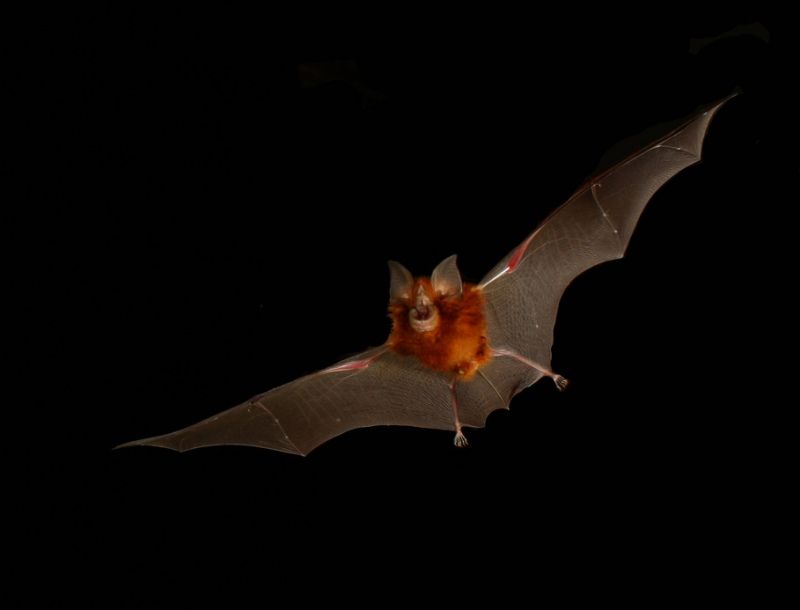
Bats from this group are found on all continents across the world except Antarctica. In Australia there are many species of microbats, ranging from the carnivorous ghost bat — the largest, weighing up to 150 grams — to tiny forest bats weighing 3 grams.
Why are microbats important?
Microbats eat vast numbers of insects, contributing to the control of insect populations in the natural environment. This matters to modern society because they also control many insect pests of crops, and insects that spread disease.
What do microbats eat?
Each species eats different sized food, including mice, frogs, other bats, small birds, fish, large grasshoppers, moths, caterpillars, beetles, bugs, spiders, scorpions, cockroaches, flies, ants, mosquitoes, termites and gnats. On the American continents there are microbat species which also feed on fruit, flowers and blood.
What sounds do microbats make?
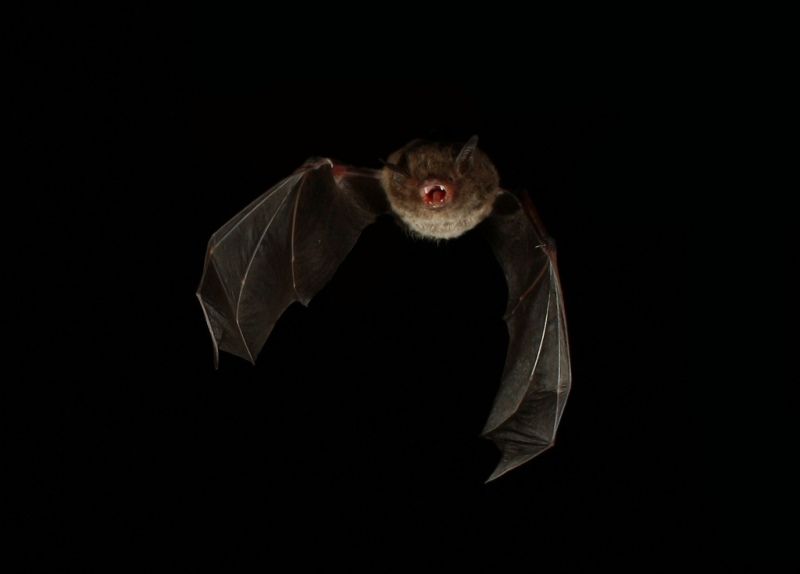
Microbats find their way in the dark and catch their food using echolocation. High frequency sound pulses made in the larynx (voicebox) are emitted either through the nose or mouth. Echoes of these sounds reflect back to the bat's ears, allowing it to know the position, relative distance and character of objects in its environment. The echolocation sounds are nearly all above the hearing range of people. Microbats use other sounds for communication, particularly in the roost.
Where do microbats go in the daytime?
Some microbat species live in caves in large colonies. Other species roost in hollows in trees, under bark, in small holes in logs or fence posts, in birds' nests, under bridges, and in the roofs or walls of buildings. Radio-tracking of individual microbats has shown that they use a number of different roosts in an area. Microbats rarely move about in daylight.
Roosting in the Sydney region
Four species are predominantly cave-roosting, sheltering during the day in caves, mines, tunnels, culverts and stone basements.
The remaining 15 species roost during the day in tree hollows, under bark and in buildings. Females choose hollows in large old trees to rear their pups because of the thermal properties of the wood.
Gould's wattled bat is the only species that has been regularly recorded roosting in buildings within the Sydney area. More about bats in buildings (PDF), and the Australasian Bat Society's bats in buildings FAQ.
The large bent-wing bat roosts in man-made structures including a disused railway tunnel, a water reservoir, disused military bunkers, a water diversion tunnel and stormwater drains.
Where do microbats go during the night?
They go hunting for food. Most catch prey in flight, but a few species hunt on all fours for ground-living invertebrates.
What do microbats do in the winter?
In winter there are few insects about, so microbats in cold climates (for example southern Australia) save energy by hibernating. They roost in a cold sheltered place, drop their body temperature close to that of their surroundings, and slow their heart rate.
Microbats can also use torpor, which is like hibernation but used only for a few hours or days to conserve energy when food is scarce.
When and where do microbats have their babies?
Microbat pups are born in spring and summer when days are warm and food is plentiful. Most species give birth to one young per year. Newborn microbats are not furred, and their eyes are closed at first. By 6–8 weeks they are fully developed and able to fly and feed with the adults.
Some species give birth in maternity caves, where the shape of the cave roof traps the body heat of the adults so that the unfurred young can survive when the mothers leave them to feed at night. Other species form maternity colonies in the hollows of big old trees, or in buildings. Mother microbats which roost in tree hollows carry their babies from one hollow to another. This behaviour may be to avoid predators, or to avoid a build-up of parasites, or both.
Conservation
For tree-roosting microbats, conservation of forests is the only reliable method of providing enough big old trees with hollows for them. Provision of artificial nest boxes in urban areas may augment roosting habitat for some species.
Threats
- Habitat destruction — removal of trees, especially large ones, and changes to roads and bridges
- Cat predation, especially for slow-flying species that forage near the ground such as the lesser long-eared bat
- Bright light shed into bushland
- Motor vehicle impact
What you can do
- Help conserve old-growth forests and native trees in urban areas, especially large ones
- Keep cats indoors
- Minimise outdoor lighting — see the Australasian Bat Society's Bats need dark skies (PDF)
- Minimise use of herbicides and pesticides
- Install a bat box
Echolocating bats recorded in the Sydney region
Many of these species are listed as threatened under the NSW Biodiversity Conservation Act 2016: eight of the nineteen are listed.
V Vulnerable E Endangered
- White-striped free-tailed bat Austronomus australis
- Large-eared pied bat E Chalinolobus dwyeri
- Gould's wattled bat Chalinolobus gouldii
- Chocolate wattled bat Chalinolobus morio
- Eastern falsistrelle V Falsistrellus tasmaniensis
- Eastern coastal free-tailed bat V Micronomus norfolkensis
- Little bent-winged bat V Miniopterus australis
- Eastern bent-winged bat V Miniopterus orianae oceanensis
- Large-footed myotis V Myotis macropus
- Lesser long-eared bat Nyctophilus geoffroyi
- Gould's long-eared bat Nyctophilus gouldi
- Ride's free-tailed bat Ozimops ridei
- Eastern horseshoe bat Rhinolophus megaphyllus
- Yellow-bellied sheath-tailed bat V Saccolaimus flaviventris
- Greater broad-nosed bat V Scoteanax rueppellii
- Eastern broad-nosed bat Scotorepens orion
- Large forest bat Vespadelus darlingtonia
- Eastern forest bat Vespadelus pumilus
- Little forest bat Vespadelus vulturnus
More about microbats
- Australasian Bat Society — maps of every Australian bat species and excellent fact sheets
- Australian Museum — bats
- Microbat gallery — photographs of the species recorded around Sydney
- Microbats of Sydney poster